© Export Finance Australia
The views expressed in World Risk Developments represent those of Export Finance Australia at the time of publication and are subject to change. They do not represent the views of the Australian Government. The information in this report is published for general information only and does not comprise advice or a recommendation of any kind. While Export Finance Australia endeavours to ensure this information is accurate and current at the time of publication, Export Finance Australia makes no representation or warranty as to its reliability, accuracy or completeness. To the maximum extent permitted by law, Export Finance Australia will not be liable to you or any other person for any loss or damage suffered or incurred by any person arising from any act, or failure to act, on the basis of any information or opinions contained in this report.
India—High growth and capital expenditure create export opportunities
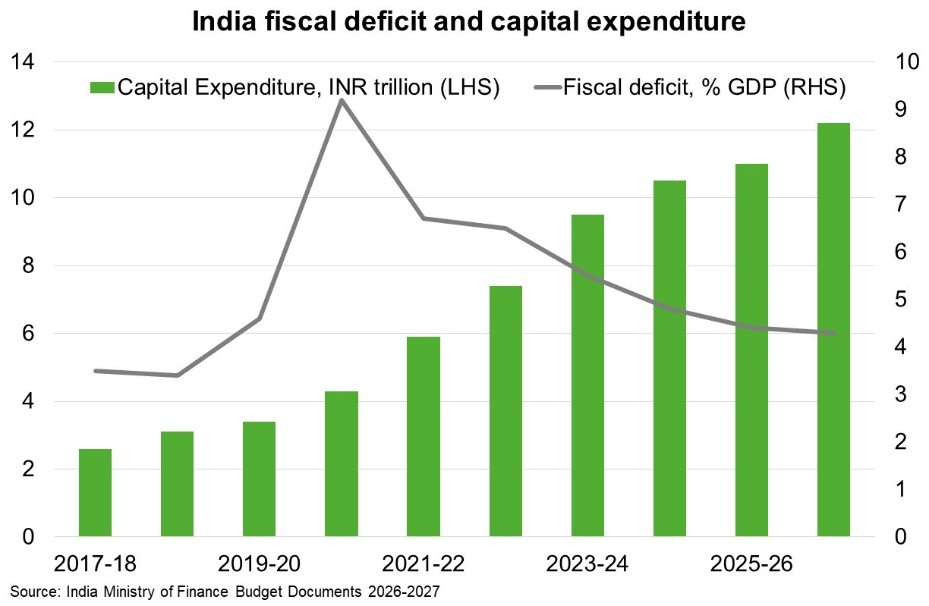
India is expected to remain the world’s fastest growing large economy this year, despite GDP growth moderating to 6.4% from 7.3% in 2025. Strong private consumption will be supported by rising real incomes as inflation remains low and consumption taxes decline. Meanwhile, buoyant investment will be sustained by declining borrowing costs and strong public investment in infrastructure. Indeed, the budget for fiscal year FY2027 (April-March) released this month increases capital expenditure by 11% from last year’s record INR11 trillion ($172 billion, Chart). Still, the budget balances economic stimulus with financial prudence; the fiscal deficit remains at 4.4% of GDP and the debt-to-GDP ratio is trimmed in line with a target of 50% by FY2031, bolstering long term economic stability.
Efforts to enhance transport and critical infrastructure support India’s ambition to become a global manufacturing powerhouse (and bolster manufacturing’s contribution to GDP to 25% by 2035), including by encouraging more private investment and deepening financial markets. This builds on a “reform express” drive launched last year that simplified the goods and services tax regime, implemented new business-friendly labour codes, and increased foreign investment in insurance. These efforts will also be aided by a flurry of free trade agreements recently concluded with the UK, Oman, New Zealand and the EU. Moreover, India will most likely benefit from the Supreme Court striking down International Emergency Economic Powers Act tariffs, despite the White House subsequently imposing a 15% tariff on most imports under Section 122 of the Trade Act of 1974. This may boost confidence in India’s export-oriented manufacturing potential.
Australia’s exports to India have rebounded since the pandemic, to $35 billion, led by strong growth in education related travel. India is now Australia’s fifth largest overseas market with an increasingly diversified export mix. High rates of economic growth and infrastructure development will create new export demand while improved critical infrastructure and business operating environments will improve market access and ease of doing business.