© Export Finance Australia
The views expressed in World Risk Developments represent those of Export Finance Australia at the time of publication and are subject to change. They do not represent the views of the Australian Government. The information in this report is published for general information only and does not comprise advice or a recommendation of any kind. While Export Finance Australia endeavours to ensure this information is accurate and current at the time of publication, Export Finance Australia makes no representation or warranty as to its reliability, accuracy or completeness. To the maximum extent permitted by law, Export Finance Australia will not be liable to you or any other person for any loss or damage suffered or incurred by any person arising from any act, or failure to act, on the basis of any information or opinions contained in this report.
Major emerging markets—Improved governance supports growth outlook
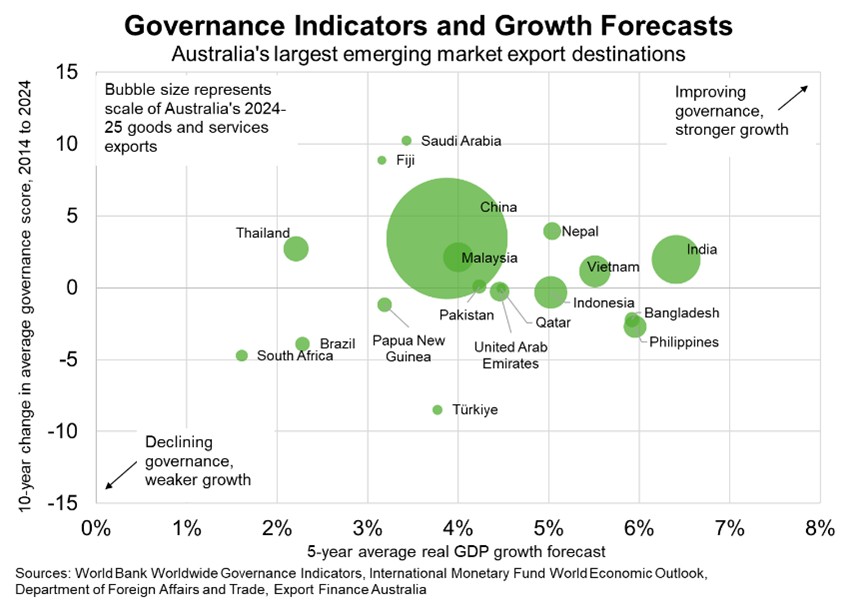
Public sector governance improved in Australia’s major emerging market export destinations in 2024, according to recently released World Bank data. Improved governance provides a foundation for stronger and less volatile macroeconomic performance, fostering investor confidence and lowering country risk. Among Australia’s largest emerging market export destinations, indicators of governance quality were highest in the United Arab Emirates (with an average score of 68, where 0=lowest and 100=best possible score), Qatar (66), Malaysia (64), Fiji (64) and Saudi Arabia (59). Strong improvements between 2023 and 2024 surveys were seen in Saudi Arabia (up 2.3 points), Sri Lanka (up 2.1 points), Malaysia (up 1.9 points), Fiji (up 1.0 point) and India (up 0.6 points).
While institutional quality can deteriorate quickly, improvements tend to accrue and shape economic growth outcomes over a longer period of time. Consistent improvement over the past 10 years is seen most strongly in Saudi Arabia, where all indicators except those on voice and accountability have improved steadily; Fiji, where the return to democracy coincided with average governance indicators rising 16% since 2014; and Nepal, though recent political instability will weigh on growth and governance in coming years. India’s scores steadily improved with persistent infrastructure development and growing capital markets, and in Gulf Cooperation Council (GCC) countries where reforms to improve the business environment have taken effect. Vietnam’s ambitious bureaucratic reform in 2025 will improve government efficiency and compound its 2.4% governance score improvement of the last 10 years.
Stronger economic growth—and by extension, better prospects for Australian export growth—is associated with better regulatory quality, government effectiveness, rule of law, political stability, control of corruption, and voice and accountability (Chart). Indeed, IMF growth forecasts are stronger in emerging markets where these indicators improved, especially India and Vietnam.