© Export Finance Australia
The views expressed in World Risk Developments represent those of Export Finance Australia at the time of publication and are subject to change. They do not represent the views of the Australian Government. The information in this report is published for general information only and does not comprise advice or a recommendation of any kind. While Export Finance Australia endeavours to ensure this information is accurate and current at the time of publication, Export Finance Australia makes no representation or warranty as to its reliability, accuracy or completeness. To the maximum extent permitted by law, Export Finance Australia will not be liable to you or any other person for any loss or damage suffered or incurred by any person arising from any act, or failure to act, on the basis of any information or opinions contained in this report.
World—Economic outlook resilient, but downside risks persist
The IMF forecasts global economic growth to remain resilient at 3.3% in 2026 and 3.2% in 2027, despite higher tariffs and policy uncertainty. Activity is supported by surging artificial intelligence (AI)-related investment, fiscal and monetary policy support, private sector adaptability and resilient consumption. In particular, these factors prompted the IMF to upgrade its 2026 US economic growth forecast to 2.4% last month, from 2.1% forecast in October and estimated growth of 2.1% last year. Still, emerging Asia will continue to account for most of global growth, particularly China, India and ASEAN economies—which collectively account for almost half of Australia’s export demand.
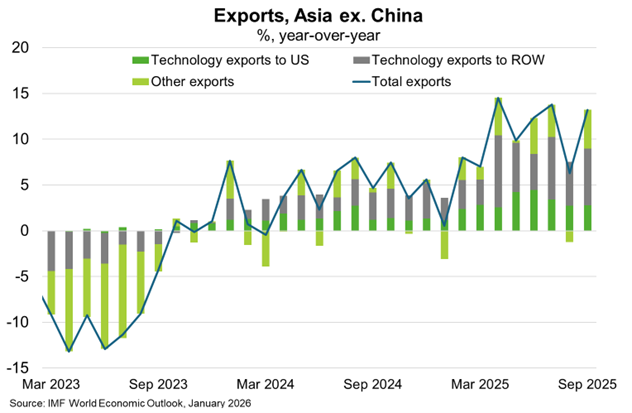
Risks to the outlook remain large. First, an AI-led investment boom and stock market surge has bolstered wealth and consumption in the US and generated positive spillovers for Asia’s technology exports (Chart). However, a re-evaluation of productivity growth and profitability expectations surrounding AI could lower investment and trigger an abrupt financial market correction. Second, the IMF highlights overall impact on global economic activity of prolonged uncertainty in trade policy. In the US, the White House responded to the Supreme Court’s striking down International Emergency Economic Powers Act tariffs by imposing a 15% tariff on most imports under Section 122 of the Trade Act of 1974 (effective 24 February for 150 days). While the move reduces the US trade-weighted average tariff rate to 13.2%, compared with 15.3% before the Supreme Court ruling, it illustrates the risk of ongoing uncertainty as tariff composition changes and the possibility of trade tensions flaring again. Indeed, Global Trade Alert documented almost 600 trade and industrial policy developments during January, highlighting a continued global trend in the use of trade policy as a tool of economic security. Third, geopolitical tensions or domestic political tensions could erupt, disrupting the global economy via financial markets, supply chains and commodity prices. Indeed, geoeconomic confrontation was top of mind for respondents to the World Economic Forum’s recent Global Risks Perception Survey. 18% of respondents said this was the risk most likely to trigger a material global crisis this year, while a further 14% cited state-based armed conflict. Last, large fiscal deficits and high public debt could put pressure on long term interest rates and broader financial conditions.