© Export Finance Australia
The views expressed in World Risk Developments represent those of Export Finance Australia at the time of publication and are subject to change. They do not represent the views of the Australian Government. The information in this report is published for general information only and does not comprise advice or a recommendation of any kind. While Export Finance Australia endeavours to ensure this information is accurate and current at the time of publication, Export Finance Australia makes no representation or warranty as to its reliability, accuracy or completeness. To the maximum extent permitted by law, Export Finance Australia will not be liable to you or any other person for any loss or damage suffered or incurred by any person arising from any act, or failure to act, on the basis of any information or opinions contained in this report.
Indo-Pacific—El Niño compounds existing stressors
A new El Niño event has been officially declared, raising the risk of extreme weather across the Indo-Pacific through late 2026 and into 2027. Several models forecast that the current El Nino could be among the strongest on record. Impacts are expected to vary significantly between countries and regions. Past El Niño events have weighed heavily on global economic growth, including by depressing investment in the years following the initial event. Coming amid elevated geopolitical tensions and trade disruptions, El Niño threatens to amplify existing inflationary and supply-chain pressures.
Tighter agricultural supply will exacerbate stresses on global food supply chains and prices from disrupted fuel and fertiliser supplies, particularly where adverse weather affects major producing regions or where global stocks are already constrained. Food price pressures could induce higher interest rates if inflation accelerates or inflation expectations become unanchored. Weaker rural incomes could exacerbate income inequality, and cost of living increases add pressure to social cohesion. Beyond agriculture, extreme heat and water shortages can disrupt industrial activity, for instance via heat-related productivity losses, higher cooling costs for data centres, and constrained operations in water-intensive mines. El Niño is also a supply-chain risk given disruptions to land and maritime routes. For instance, low water levels in the Rhine River and Panama Canal add to existing pressures in the Strait of Hormuz, Bab el-Mandeb Strait and Black Sea. Meanwhile, tourism could be affected as extreme weather reduces the attractiveness of some destinations.
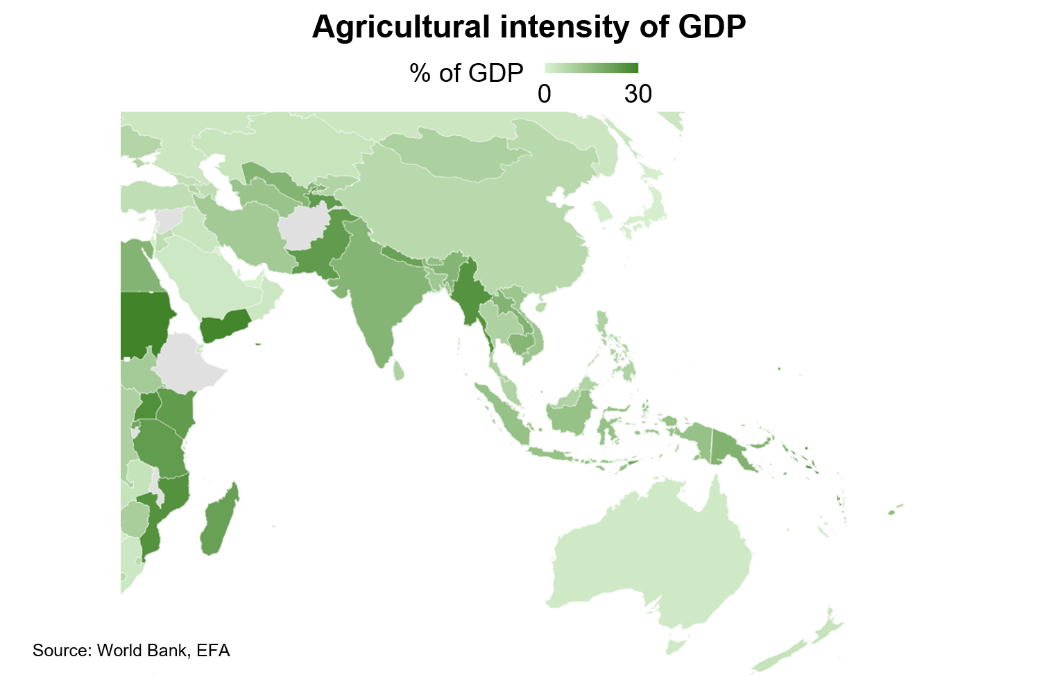
Large agricultural producers (Chart) are particularly exposed, especially in South and Southeast Asia where currency weakness amplifies higher food import costs. Pacific economies face additional pressure through extreme weather, elevated fuel costs and transport disruptions. PNG is especially vulnerable due to its reliance on agriculture and exposure to mining disruptions.