© Export Finance Australia
The views expressed in World Risk Developments represent those of Export Finance Australia at the time of publication and are subject to change. They do not represent the views of the Australian Government. The information in this report is published for general information only and does not comprise advice or a recommendation of any kind. While Export Finance Australia endeavours to ensure this information is accurate and current at the time of publication, Export Finance Australia makes no representation or warranty as to its reliability, accuracy or completeness. To the maximum extent permitted by law, Export Finance Australia will not be liable to you or any other person for any loss or damage suffered or incurred by any person arising from any act, or failure to act, on the basis of any information or opinions contained in this report.
World—Economic disruption likely to rise as oil inventory buffers fall
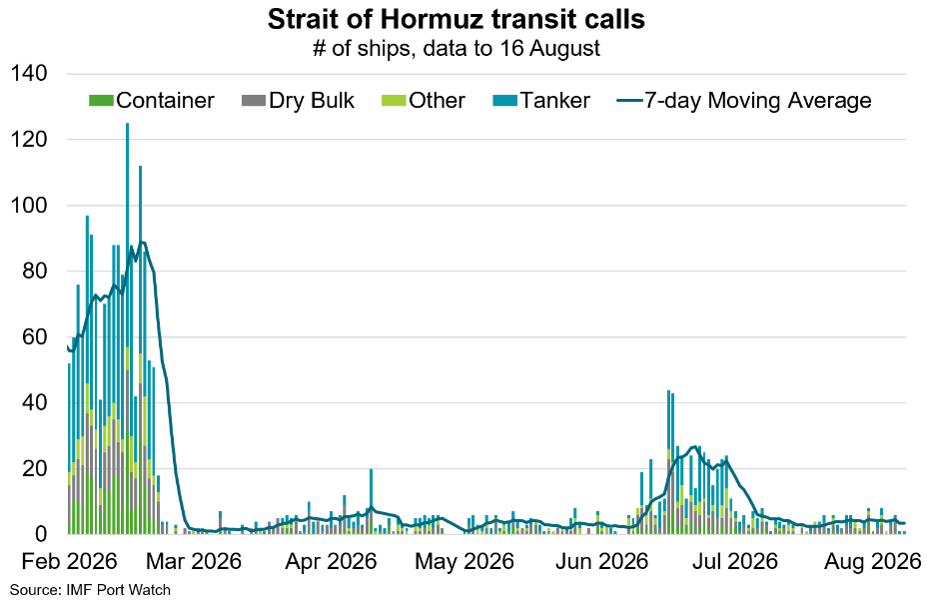
Oil market disruption is likely to increase as Middle East supply risks persist and inventory buffers shrink. A durable deal to reopen the Strait of Hormuz, which typically handles around a fifth of global oil and gas flows, remains elusive. Following renewed disruptions from late July (Chart), Tehran has set maximalist conditions, including the US lifting its naval blockade, removing sanctions, unfreezing assets and paying reparations. Meanwhile, Huthi attacks threaten Saudi exports through the Bab al-Mandab strait, adding to the cost of delivering oil to customers through alternative routes.
Sharply lower Chinese crude imports, strategic reserve releases and softer demand have helped absorb the shock and contain oil prices so far. But buffers are diminishing. On 12 August, the IEA estimated the global oil deficit would reach 1.8 mb/d in Q3 2026, more than double its estimate a month earlier. The US Strategic Petroleum Reserve fell to 299 mb on 7 August, the lowest since 1983 and near the estimated minimum operational range of 250–300 mb. If hostilities continue to obstruct Middle Eastern oil flows, global inventories could reach stress levels, raising the risk of shortages in exposed sectors and regions. Indeed, refined product markets including diesel are already indicating supply stress.
The economic impact would broaden beyond energy markets. Higher oil-product, shipping and insurance prices would lift transport and production costs, driving up inflation and interest rates. Countries reliant on food and energy imports, especially those with limited fiscal buffers or strategic reserves, would be most exposed to financial stress, social unrest and political instability. Australia’s major trading partners are still growing faster than expected as the boost from AI-related investment outweighs the negative effects of the Middle East conflict. However, cost pressures and uncertainty are weighing on export conditions. The NAB Business Survey suggests Australian businesses are already deeply pessimistic; confidence remained at -6 in July, in the bottom 10% of outcomes since 1997.