© Export Finance Australia
The views expressed in World Risk Developments represent those of Export Finance Australia at the time of publication and are subject to change. They do not represent the views of the Australian Government. The information in this report is published for general information only and does not comprise advice or a recommendation of any kind. While Export Finance Australia endeavours to ensure this information is accurate and current at the time of publication, Export Finance Australia makes no representation or warranty as to its reliability, accuracy or completeness. To the maximum extent permitted by law, Export Finance Australia will not be liable to you or any other person for any loss or damage suffered or incurred by any person arising from any act, or failure to act, on the basis of any information or opinions contained in this report.
World—Artificial intelligence provides upside for growth and productivity
Artificial intelligence (AI) driven productivity improvements provide broad upside for global growth. The IMF estimates AI could contribute up to an additional 0.3 percentage points to global growth in the near term and up to 0.8 percentage points in the medium term. Increased productivity drives higher incomes and living standards, and is pertinent in Australia where demand outstripping the economy’s productive capacity puts pressure on inflation and interest rates.
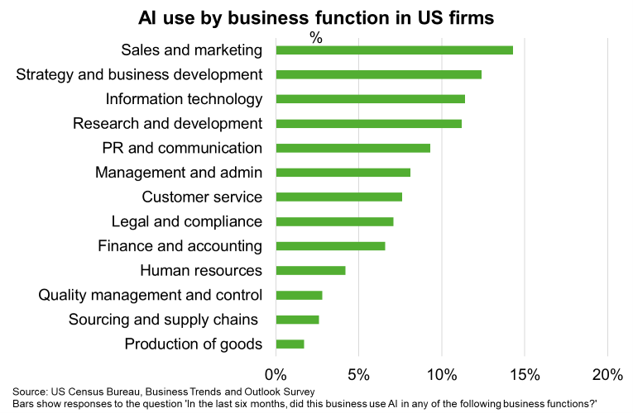
Heterogeneity in AI adoption exists both within and between sectors. A US survey of business trends shows sales and marketing, strategy and business development, IT and research and development as the functions most commonly supported by AI (Chart). IT and professional services led sectoral uptake with 40% and 37% of firms respectively reporting using AI in May 2026. The education (35%), financial services (34%), real estate (24%), health and social assistance (22%) sectors also reported relatively high AI use. Firms using AI primarily used the technology to supplement or enhance existing tasks performed by employees (44% of all respondents), and to perform new tasks (11%), rather than to perform tasks previously undertaken by human workers (10%, noting that a job comprises a multitude of tasks). US analysis shows labour productivity strengthening in 2026, reflecting improved speed and accuracy, reallocation of time towards more valuable tasks, and revenue from new products and quality improvements, rather than simple cost reduction.
Concern about sudden asset repricing in AI related equities, and consequent risk to financial market stability, has eased recently with strong earnings performance among tech firms. Residual risk remains around: 1) growing effectiveness of AI enabled cyber-attacks, however this could present opportunities for Australian cyber security companies, and 2) distributional effects if labour market impacts are concentrated in vulnerable groups and contribute to widening inequality or social disharmony.