© Export Finance Australia
The views expressed in World Risk Developments represent those of Export Finance Australia at the time of publication and are subject to change. They do not represent the views of the Australian Government. The information in this report is published for general information only and does not comprise advice or a recommendation of any kind. While Export Finance Australia endeavours to ensure this information is accurate and current at the time of publication, Export Finance Australia makes no representation or warranty as to its reliability, accuracy or completeness. To the maximum extent permitted by law, Export Finance Australia will not be liable to you or any other person for any loss or damage suffered or incurred by any person arising from any act, or failure to act, on the basis of any information or opinions contained in this report.
Australia—Exports resilient despite challenging business conditions
Australian businesses face weak demand, high energy and borrowing costs, and persistent uncertainty. The October NAB Business Survey saw confidence slip to within the bottom 5% of outcomes on record as input costs continue to rise faster than output prices, squeezing profit margins. The Reserve Bank of Australia materially raised its inflation forecasts this month, reflecting domestic capacity pressures and higher global energy prices. Inflation is now expected to return to the midpoint of the 2–3% target range only in mid-2028, with risks tilted toward higher for longer inflation. Interest rates are now at their highest level since 2008, adding to business costs. Meanwhile, weak demand remains the main constraint on industrial production, with labour shortages expected to ease.
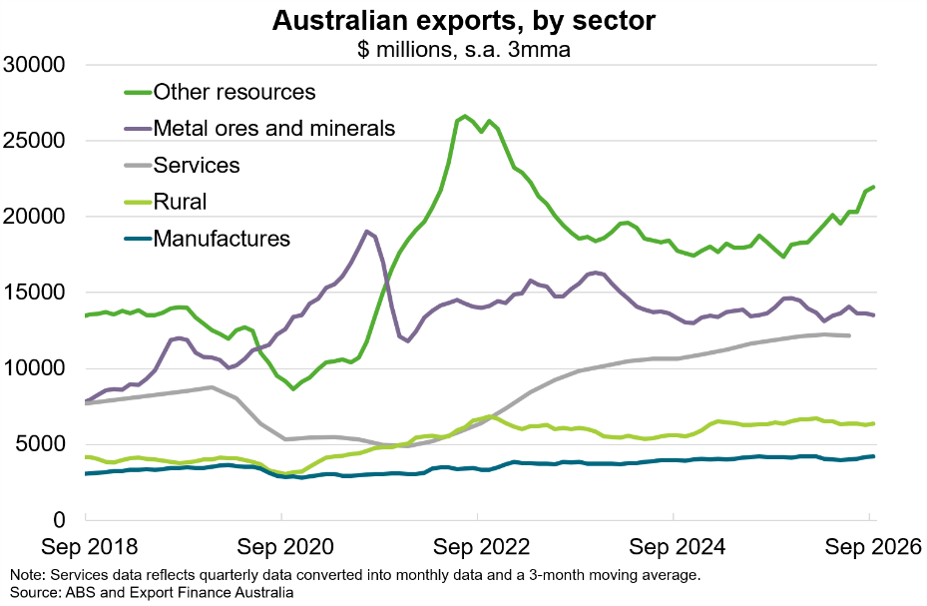
Despite challenging domestic conditions, Australian exports remain resilient (Chart). Services exports increased 9% in FY2026, while goods exports grew 6% in the year to September compared with the same period a year earlier, with growth broad-based across rural, manufactured and resources exports. Iron ore is the only major resource export expected to end 2026 with prices below their level a year earlier.
The outlook remains broadly supportive. Middle East supply disruptions and high base metal prices linked to AI investment and energy security are forecast to increase resource and energy exports by 5% to $422 billion in FY2027. Agricultural exports are forecast to decline 5% to $76 billion but remain the sixth-highest result on record in real terms. Services and manufacturing exports will derive support from the improved growth outlook for Australia’s major trading partners owing to a stronger outlook for AI-related activity. A softer Australian dollar, which has fallen 8% against the USD from its September peak, also improves Australia’s international competitiveness, with higher forecast US interest rates adding downward pressure. However, changes to student visa settings, disruptions to travel from the Middle East conflict, China’s weak domestic economy and higher imported inflation present ongoing risks.