© Export Finance Australia
The views expressed in World Risk Developments represent those of Export Finance Australia at the time of publication and are subject to change. They do not represent the views of the Australian Government. The information in this report is published for general information only and does not comprise advice or a recommendation of any kind. While Export Finance Australia endeavours to ensure this information is accurate and current at the time of publication, Export Finance Australia makes no representation or warranty as to its reliability, accuracy or completeness. To the maximum extent permitted by law, Export Finance Australia will not be liable to you or any other person for any loss or damage suffered or incurred by any person arising from any act, or failure to act, on the basis of any information or opinions contained in this report.
Vietnam—Sustained growth now surging with export boom
Vietnam remains among the world’s fastest-growing economies in 2026 with the IMF revising its forecast up to 9.2% in 2026 and 8.9% in 2027. Vietnam was upgraded to upper-middle income status by the World Bank in July, reflecting its sustained per capita income increases. Vietnam is also an increasingly important export market, with Australia’s exports growing at an annual average rate of 12% over the five years to 2025, to $13 billion.
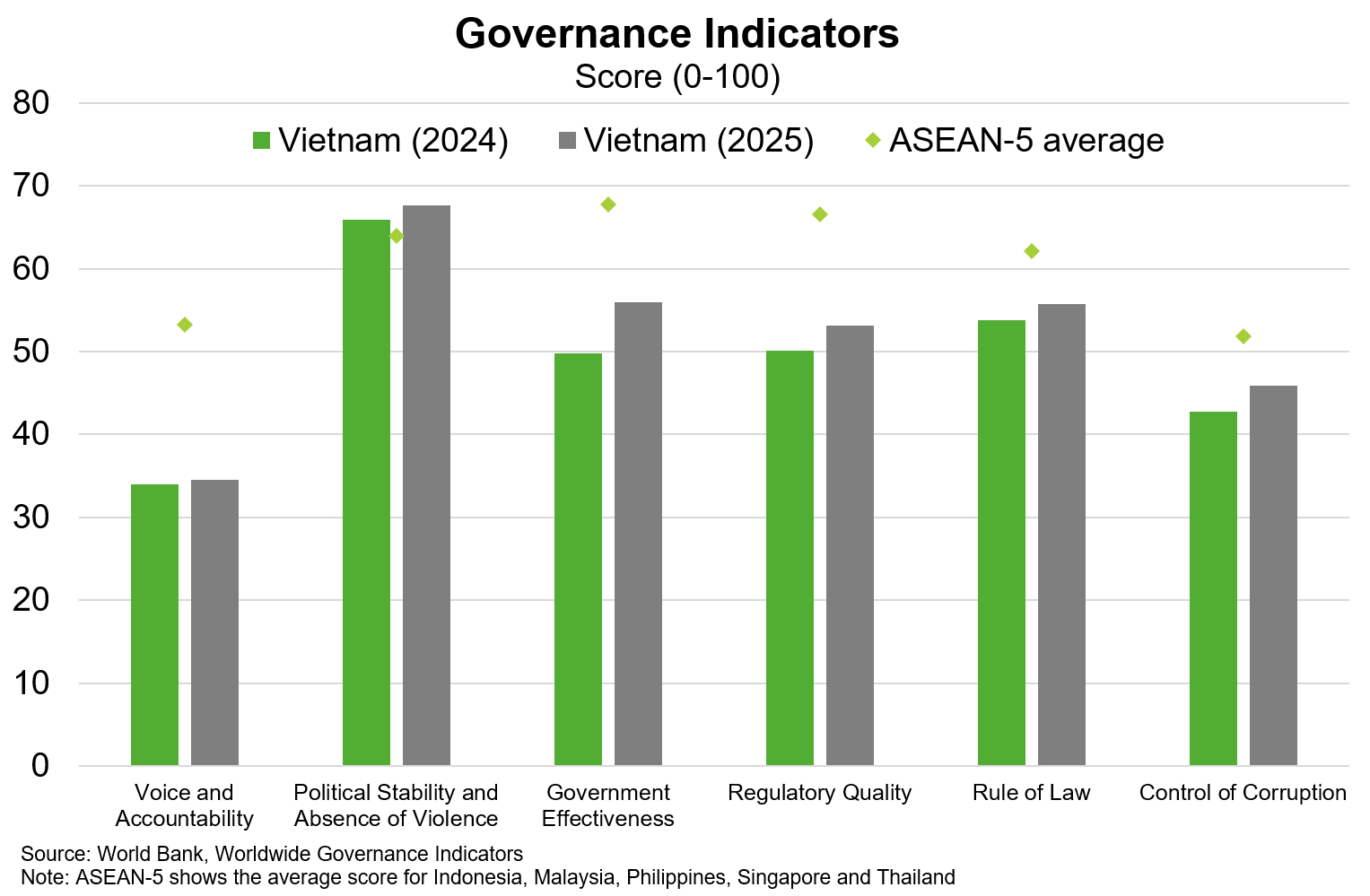
Surging electronics exports and investment related to global AI-demand is driving growth. Exports rose 51% y/y in October resulting in a record monthly trade surplus of US$7.3 billion, with electronics accounting for almost half of export revenue. Momentum is broadening across the economy. For example, tourism is growing with eased visa restrictions, destination promotion and increasingly diversified source markets. Income gains and job creation support private consumption even amid inflationary pressures. Robust foreign direct investment continues to benefit from pro-growth government policy, including capital market reforms that are incrementally broadening funding sources. Meanwhile, government efforts to reduce bureaucracy, address corruption and improve regulatory quality are improving governance indicators towards the average of large ASEAN economies (Chart).
However, surging growth is increasing macro-financial vulnerabilities. Rapid credit growth and high leverage overlay lingering weakness in the property sector, which adds strain to the banking sector. Business will continue to benefit from improved public infrastructure, but strong public investment growth may strain financing and implementation capacity. More broadly, Vietnam remains highly exposed to the global AI cycle, given its reliance on a narrow set of electronics exports, as well as US trade policy. Upcoming findings from the US Trade Representative on industrial overcapacity and intellectual property could undermine exports and growth, with energy price shocks and extreme weather also presenting downside risks.