© Export Finance Australia
The views expressed in World Risk Developments represent those of Export Finance Australia at the time of publication and are subject to change. They do not represent the views of the Australian Government. The information in this report is published for general information only and does not comprise advice or a recommendation of any kind. While Export Finance Australia endeavours to ensure this information is accurate and current at the time of publication, Export Finance Australia makes no representation or warranty as to its reliability, accuracy or completeness. To the maximum extent permitted by law, Export Finance Australia will not be liable to you or any other person for any loss or damage suffered or incurred by any person arising from any act, or failure to act, on the basis of any information or opinions contained in this report.
World—AI risks and benefits distributed unevenly
The global economy has remained resilient despite successive shocks, with the IMF expecting global growth of 3.1% in 2026 and 3.4% in 2027. Investment in artificial intelligence (AI) has cushioned global activity, offsetting some of the economic drag from the energy shock. The IMF assumes that AI related investment will remain strong even as the pace of growth slows.
The IMF and RBA characterise AI growth as a positive near term demand shock, with productivity improvements accruing more slowly over the medium term. Near term gains are concentrated in a narrow group of economies, including China and the US—which are developing AI models—and Taiwan, South Korea and parts of Southeast Asia—which are embedded in AI hardware supply chains. Medium term benefits could become more dispersed, but so far AI uptake appears concentrated in larger firms and certain sectors including information technology, finance and professional services.
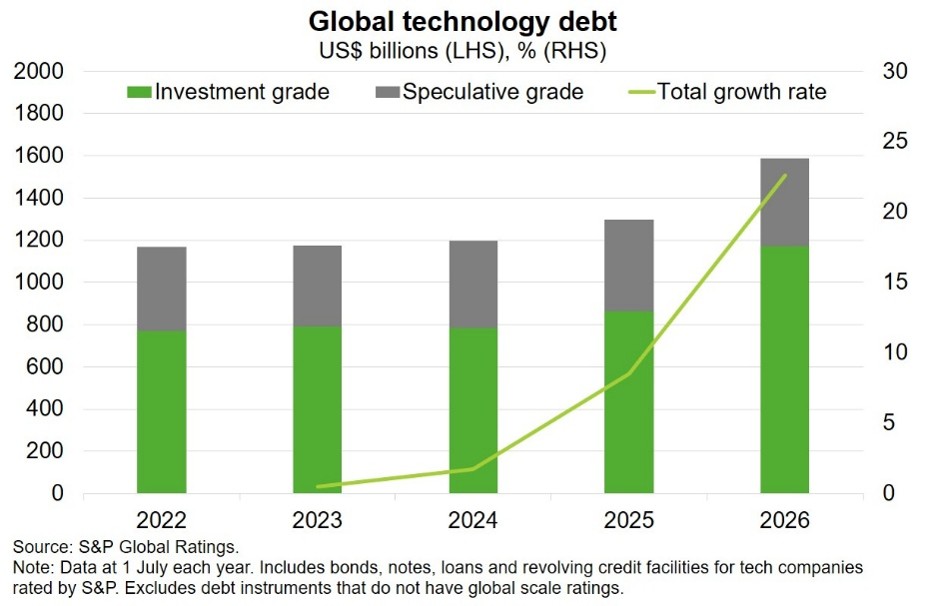
Risks could materialise if profitability expectations are reassessed, cybersecurity risks proliferate, financing conditions tighten or energy constraints impede further investment. Economies with financial exposure to AI investment have seen strong wealth growth, which could reverse quickly with asset repricing. Indeed, the ten largest heavily AI-exposed stocks make up nearly 40% of the S&P 500 index, with corporate equities comprising a higher share of household net worth than during the dotcom era. Economies benefiting from AI hardware demand may feel an investment slowdown more gradually, as large tech companies’ strong balance sheets support continued investment and construction through a downturn. Risk is most acute in highly leveraged tech companies with narrow revenue streams and interlinked leases, guarantees, purchase commitments and private credit exposures. However, growth in tech company debt is concentrated in higher quality investment grade debt, which increased 36% y/y in 2026, while speculative grade debt remained stable (Chart).