© Export Finance Australia
The views expressed in World Risk Developments represent those of Export Finance Australia at the time of publication and are subject to change. They do not represent the views of the Australian Government. The information in this report is published for general information only and does not comprise advice or a recommendation of any kind. While Export Finance Australia endeavours to ensure this information is accurate and current at the time of publication, Export Finance Australia makes no representation or warranty as to its reliability, accuracy or completeness. To the maximum extent permitted by law, Export Finance Australia will not be liable to you or any other person for any loss or damage suffered or incurred by any person arising from any act, or failure to act, on the basis of any information or opinions contained in this report.
Emerging markets—Economic strength insulates Asia from shocks
Emerging markets (EMs) were resilient throughout 2026, despite geopolitical, trade and commodity shocks. Asia was again the strongest performing EM region; the IMF forecasts growth of 5.1% in 2026, down slightly from 5.6% in 2025, with resilience stemming from trade rerouting, integration in AI supply chains and ongoing strong investment.
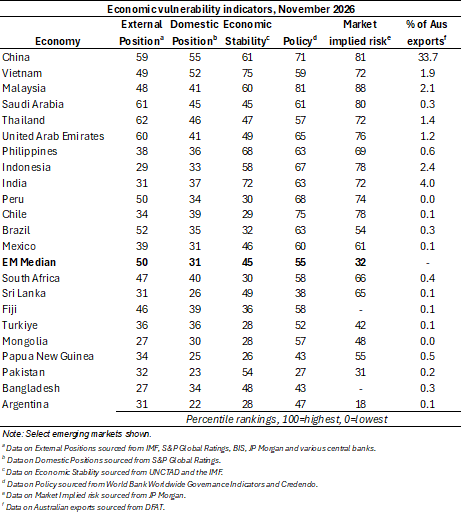
However, risks are tilted to the downside in 2027. Growth forecasts mask increasing divergence in country level conditions and thinner buffers, while elevated inflation limits policy flexibility, exacerbated by El Niño driven food price pressures. Vulnerability is most pronounced for energy importers with limited fiscal and external buffers, and for economies with limited participation in technology-driven investment. Global economic and financial institutions use a range of indicators to assess vulnerability to such risks. Together, these indicators highlight continued relative resilience for Australia’s largest EM export markets in Asia (Table).
- External position—what is the external debt and reserves position? Is the current account in deficit and how far has the currency deviated from its long term average?
- Domestic position—how leveraged is the private and public sector?
- Economic stability—what is the growth and inflation outlook? How reliant is the country on commodity exports, given the volatility in global commodity prices?
- Policy effectiveness—how effective is the regulatory environment and how severe are political risks?
- Market implied risk—what do market risk premiums on foreign currency denominated bonds imply about market risk appetite?
Asian EMs generally have stronger buffers, but vulnerabilities vary considerably. China benefits from its large and diversified economy, high domestic savings, strong external finances and export-driven demand. However, trade tensions, fiscal pressures, property sector vulnerabilities and weak consumption remain important sources of risk despite incremental policy support. India, Vietnam and Malaysia benefit from strong growth, resilient foreign investment and their role in technology supply chains. Indonesia, Philippines and Thailand benefit from sound buffers, but face vulnerability from relative institutional weakness, energy import dependence and weaker growth respectively.