© Export Finance Australia
The views expressed in World Risk Developments represent those of Export Finance Australia at the time of publication and are subject to change. They do not represent the views of the Australian Government. The information in this report is published for general information only and does not comprise advice or a recommendation of any kind. While Export Finance Australia endeavours to ensure this information is accurate and current at the time of publication, Export Finance Australia makes no representation or warranty as to its reliability, accuracy or completeness. To the maximum extent permitted by law, Export Finance Australia will not be liable to you or any other person for any loss or damage suffered or incurred by any person arising from any act, or failure to act, on the basis of any information or opinions contained in this report.
World—Record debt and rising interest rates increase vulnerabilities
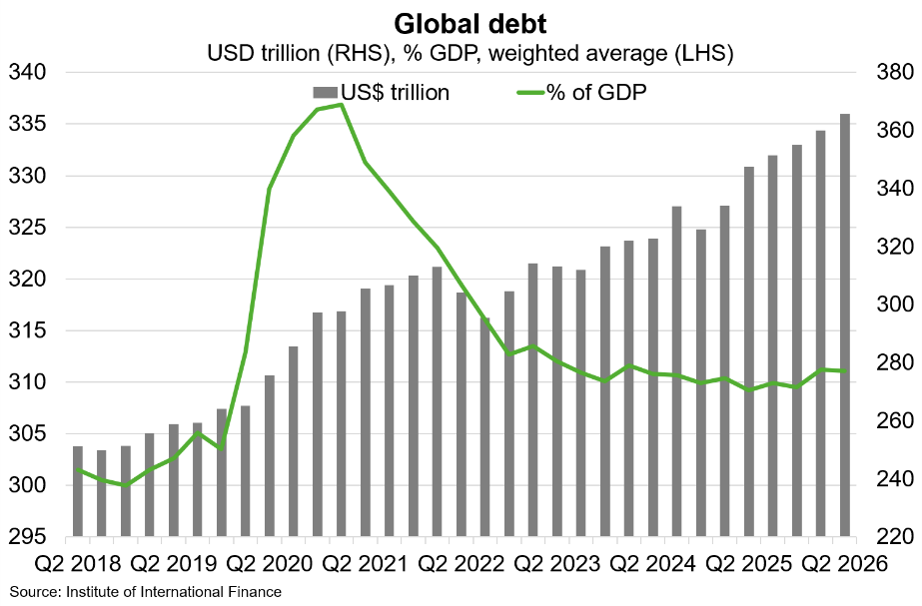
Global debt reached a record US$366 trillion in H1 2026, rising by over US$10 trillion, despite solid growth and inflation containing the debt-to-GDP ratio (Chart). The cost of servicing this debt is rising. Between February and September, G7 10-year government bond yields increased to their highest level in almost two decades. Meanwhile, advanced economies are issuing more short-maturity debt, increasing refinancing risks and allowing higher interest rates to flow quickly into government interest bills. Budget pressures are therefore intensifying; many governments now spend more on interest than on defence, clean energy or AI investment. Stabilising debt-to-GDP ratios would require greater consolidation than many governments currently envisage. The IMF forecasts a global primary deficit of 3.3% of GDP in 2026, compared with roughly 2.6% needed to stabilise debt.
Spending demands from ageing populations, energy security, AI and defence will keep borrowing needs high, while the political cost of fiscal consolidation is increasing scrutiny of policy credibility. France is particularly exposed to a potential loss of investor confidence because of its high and rising debt, political fragmentation and limited room for budget adjustment. More broadly, persistent inflation and energy pressures could keep interest rates higher for longer, further raising debt-service costs, crowding out other spending and reducing governments’ capacity to respond to future shocks
Worsening debt dynamics in advanced economies could spill over to global financing conditions. Emerging markets have remained resilient, supported by strong sovereign issuance, high commodity prices and narrow credit spreads. But this favourable window may close if higher advanced economy yields trigger a reversal in global risk appetite. Companies are also under pressure; global business insolvencies are expected to rise for a fourth consecutive year in 2026, with elevated borrowing costs weighing most heavily on SMEs and leveraged firms.